
Is Your Partner Compensation Model Outdated?
If you’ve ever worked in a professional services firm, you know that there are typically two kinds of owners / partners:
Rainmakers (bring in the work)
Service partners (actually do the work)
And it’s usually the rainmakers - i.e. the people who get a new client every time they cross the street - that get all the praise, accolades, and $$$$.
But here’s the hard truth: no firm can operate without both kinds of partners.
So how do you compensate all partners / owners fairly for their contributions?
It's an important q because I know there are many people reading this newsletter who have not seriously revisited their partnership’s income allocation model since the first Top Gun movie came out..
Let’s discuss what you might be doing:
Paying every partner the same amount. K… that works until it really, really doesn’t. Resentment becomes the name of the game as the ownership group grows and the belief that everyone is contributing equally becomes a complete fiction.
Arbitrarily paying senior partners some higher amount (like 15% of the profit pool) and junior partners some lower amount (8%) - this fails because it doesn’t incentivize junior partners who are working significantly more than senior partners to keep grinding
Reward the rainmakers aka pay partners based only on for the work they bring in the door. Again, this means only the rainmakers are making the big bucks. Is that fair when the rainmakers are usually not the ones actually servicing their clients?
From my experience inside professional services firms - almost every partnership struggles with this. And if you get partner income allocations wrong, you can look forward to stuff like partners hoarding work, zero collaboration, or partners simply running out the clock until they’re allowed to leave without losing their buy-in.
So let’s try to get it right lol.
Let’s go through an example together that uses a smarter, team-based approach that is proven to work inside high-performing professional services firms (courtesy of Dr. Heidi Gardner in Smart Collaboration).
In my example, this fictional firm has 9 partners and generates $5.4M in total revenue from 2 practice groups:
Practice Group 1 - Wills & Estates (team-based economics)
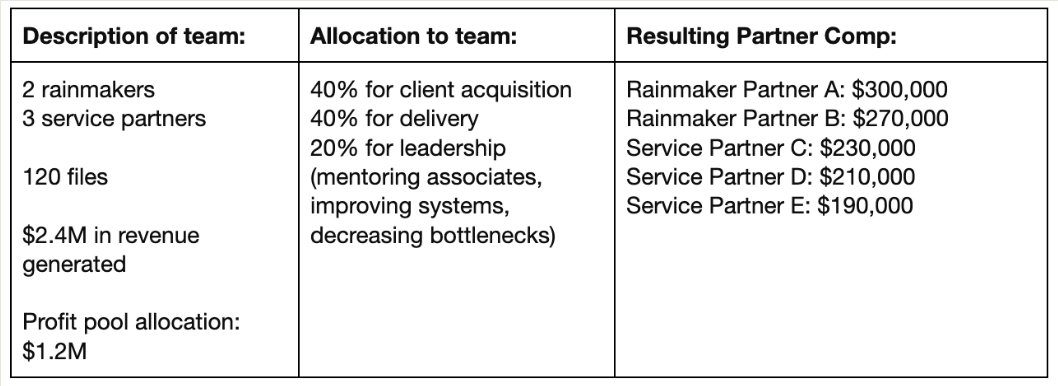
As you can see, partner comp here is not equal, but it is aligned with how value is actually created in this group.
Practice Group 2- Corporate / Commercial (deal- or project-driven economics)
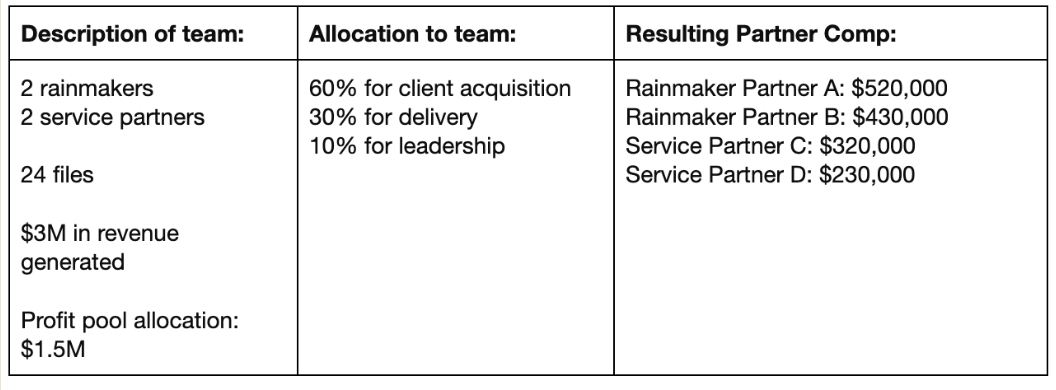
In this group, rainmaking and getting clients in the door is more important and more challenging. The comp reflects that.
The point here is that these partners all exist within the same firm, but with very different clients, different work products, and different economics - so why would partner compensation be identical or based on some arbitrary formula?
Friend - if you’re reading this and thinking ‘oh sh*t’ because your firm hasn’t revisited its partner comp model and it’s January (aka income allocation time).. you’re in good company. Most firms don’t revisit partner compensation until:
a partner threatens to leave
collaboration breaks down
or someone finally asks, “why am I working this hard for this?”
And if you’re being honest, you know that this stuff doesn’t explode overnight.
It erodes slowly… and then suddenly.
So, book a call here and let's chat: https://app.acuityscheduling.com/schedule/b7d824d2/appointment/67912755/calendar/3086653?appointmentTypeIds[]=67912755
Because yes - the best time to fix your partner compensation model was 40 years ago, when Goose was still alive and Maverick was learning about teamwork ;)
But the second-best time is before your next partner meeting.