
Is Your Rent Too High? What Business Owners Should Look at Before Signing a Lease
I have struggled with whether or not to get physical office space for at least the last 2 and a half years.
See, I have a nice office at my house. I mean, yes, I move my desk every 4-6 weeks (lol) but I have lots of light, a decent view and the cats both have their preferred sleeping spots. Plus, Anthony is gone during the day so I never have concerns around client confidentiality during Zoom meetings.
But I sometimes feel a little bit lonely because even though I work virtually with others, I’m still alone at my house during the day. And it can feel as if I haven’t quite joined the “big leagues” yet because of that.
In my wiser moments, though, I think part of my hesitation comes from the fact that I have seen the inside of hundreds of businesses in my work as a CPA-turned-management consultant, and I know how things can crumble when a big ‘ol 5-figure rent expense is added to the income statement.
And unfortunately, sometimes that pressure can be the thing that forces a business to shut its doors.
So how much is “too much” when it comes to your rent expense?
Well, luckily we have big data (aka IBISWorld Reports 2025) to tell us exactly how much you should be spending as a percentage of your annual revenue:
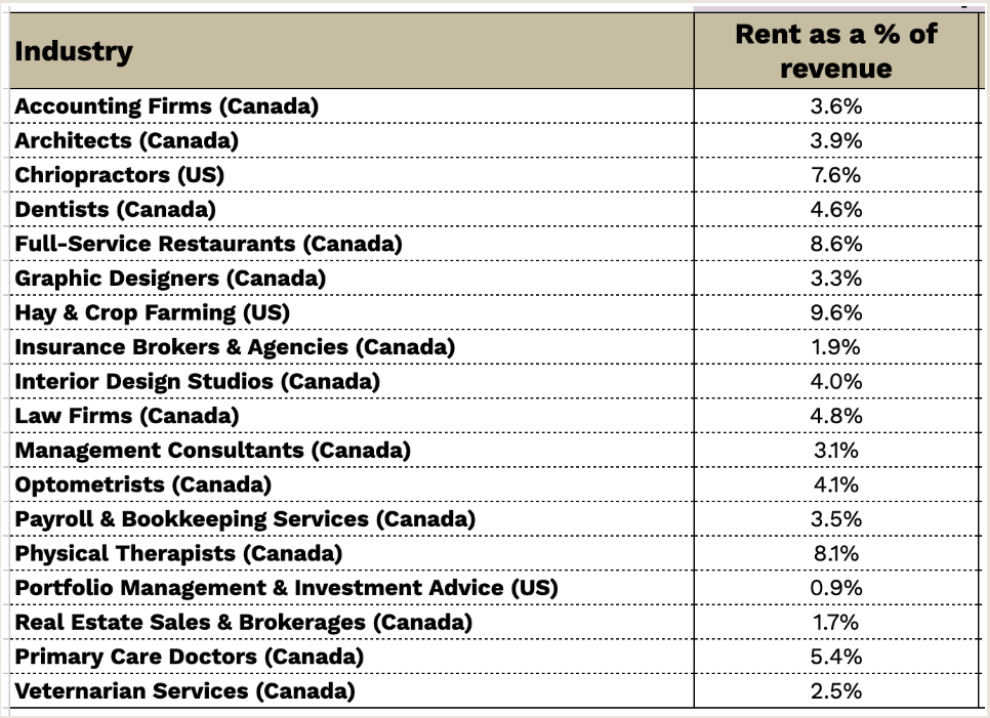
For example - if you run a restaurant and your revenue is $1,500,000 per year, you should pay about $129,000 / year or $10,750 / month in rent and occupancy costs.
Now, I can almost hear you saying: “Yikes - I just did the math. I’m an accounting partner and our firm’s rent is almost 7% of annual revenue and you’re telling me it should be 3.6%. We’re locked into a 25 year lease…. what's next?”
Well, it’s not time to call your fav commercial realtor just yet (but I know someone amazing if you need a name).
Because, sure, in an ideal world, you would’ve seen these numbers before signing / negotiating that multi-decade lease and maybe considered other options.
But we’re not living in a perfect world. And your rent as a % of revenue isn’t the only thing I care about. The better question is: can your business actually carry this expense?
Because two firms can both spend 7% of annual revenue on rent and have completely different outcomes.
One has clear roles, strong pricing, and work flowing efficiently → the office supports the business’ growth / operations
The other has bottlenecks, underpricing, and messy operations → the rent expense adds big pressure to already tight margins
Same rent expense. Very different result.
So before taking on more space, I’d want to know your:
Revenue per employee
Utilization (are employees actually doing the right tasks?)
Turnaround time on files / client work
Contribution margin by service line
Whether decisions still bottleneck at you
Because if those aren’t working… adding a bigger fixed cost will just mean more stress for you.
And for me… well, my home office still wins. For now. Not because I can’t get a space, but because I haven’t yet seen a version of my business where a physical office would really add to or support the growth of my business. If I’m being honest, it’s really just more of an ego thing…and I can let that go.
If you’re:
-considering signing a new lease,
-thinking about taking on more space,
-already sitting in a space that feels way too expensive when you look at benchmarks, and
you’re not totally sure if your business can actually carry that expense… hit reply.
We’ll look at what’s actually happening inside your business and figure out what needs to be true before you commit (or decide what to do if you already have).