
Overhead Allocation: The Hidden Driver of Business Profitability
My mom loves detective novels - especially those Kurt Wallander books set in northern Europe. Go figure. A few days ago, I started reading one she’d passed along because I needed a lighter book after finishing ‘A Thousand Splendid Suns' (btw it’s excellent, but very very heavy).
Anyway, this Wallander novel takes place in cold, dark Sweden and there are many Swedish phrases in it that I do not recognize. I mean, I know it is an entire other language, but I’m constantly flipping back because I can’t remember what certain words mean. And also, am 43…… so….lol?
This might be how you feel when I say a phrase to you like “overhead allocation methodology”.
It’s a lot of big words smushed together that, if you’re a CPA, you know exactly what they mean. And if you don’t spend your days surrounded by numbers, it might feel a bit foreign.
But here’s why you should actually care:
If your overhead allocation is off, your QBO reports can make one location (or service) look wildly profitable - when in reality, it's not carrying its share of the load.
Let’s go over an example.
Say your business just opened up a second location this year. You have shared expenses between the two locations - bookkeeping, HR, insurance, advertising, admin, etc - of about $90,000 so far. Let’s look at your numbers:
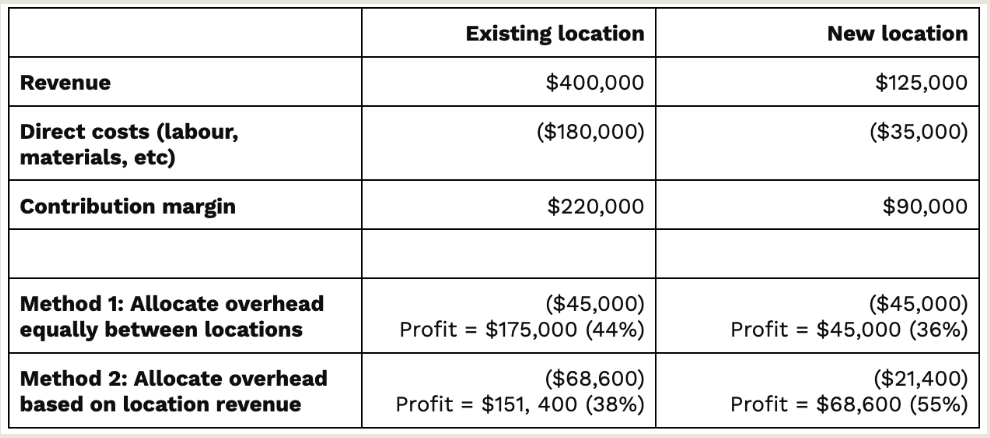
As you can see, if you looked at the profit by location report in QBO, you’d get drastically different info depending on the overhead allocation method used:
Method 1 says your existing location is doing best.
Method 2 says the new location is actually the winner.
And as your CPA-turned-management-consultant, I'd say for you to go with Method 2.
Why? Because overhead allocation should reflect how costs are actually consumed.
If your new location is only generating $125k of revenue, it’s very likely using fewer shared resources like HR, bookkeeping, and admin support. Allocating overhead purely based on a 50/50 split between 2 locations can really distort what’s really going on.
And this matters more than you might think. Because these numbers drive decisions like:
-where you invest
-what you scale / grow
-and what you think is “working”
So if you’ve ever felt like a location (or service) looks profitable on paper, but there’s never as much excess cash as you’d expect, there's a good chance overhead allocation is part of the problem.
If you want a second set of eyes on things, I’m always happy to take a look.